Wednesday, April 3, 2013

April 2013 Newsletter

GBA Monthly Newsletter

Editors:  Gina Gallucci and Linda Tillman

Spring in N Carolina - in many of the last few years, March has been our coldest month in the South
Photo by Deborah Palmer on 3/26/2013 at her apiary near Asheville, NC

Message from our President, Jerry Edwards

Ah, spring has arrived!  Nature has responded by introducing new lives, and with this thought in mind, I visited my hives.  Instead of thriving colonies, I found several with no bees.  The situation must be similar for many, as I have received numerous calls from other beekeepers, many of them strangers, voicing the same woes.  Is this the plight of the modern day beekeeper?  As most Georgia beekeepers are aware, researchers at UGA, among others, are working to resolve this problem.  Hopefully a solution will be forthcoming soon.  

On another note, it's time to "super up" and prepare for the fall meeting, which is scheduled for Gainesville, September 21.  It's a great opportunity to meet fellow beekeepers.

Jerry Edwards, President GA Beekeepers
Saving the world, one bee at a time

~~~~~~~~~~~~~~~~~~~~~~~~~~~~~~

2013 American Beekeeping Federation Annual Convention
by Virginia Webb, ABF Director for Georgia

The American Beekeeping Federation met this year at the historic Hershey Lodge in Hershey, PA for their annual convention.  Over 700 individuals attended this four day event that included one of the largest industry vendor show in the US.  The convention began with the keynote speaker, May Berenbaum, professor and entomologist at the University of Illinois, and with an update on the legislative issues from Washington, DC.  Along with a new Congress, this year we also have to work with the Farm Bill.

The first day offered afternoon breakout sessions that highlighted queen rearing by Sue Cobey; fungicide effects on honey bees and breeding better queens by David Tarpy; importance of drones, report on bee losses, and pesticides and bees by Maryann Frazier; and a wonderful cooking demonstration by the head chef at the Hershey Lodge.

Each of the beekeeping labs gave reports and updates on specific research being conducted at their labe, which included updates on CCD outbreak by the USA-ARS labe in Beltsville, MD.

Many of the talks given highlighted the shortage of bees in California for the upcoming almond  pollination season.  Some of the largest attended sessions were held in conjunction with the Serious Sideliner Symposium, sponsored by Dr. Larry Conner.  The focus was on queen management and improving the small scale beekeeper.

At the American Beekeeping Federation, members are invited to enter the American Honey Show.  This is a prime opportunity to showcase your bees' ability to produce the purest honey, the best beeswax.

The annual Honey show includes 12 classes for honey, four for beeswax and a gift basket class.  Over 80 entries were entered at this year's event, held in Hershey, Pennsylvania.  Each first place winner receives a ribbon and a crystal bowl for their entry.

From Georgia, Virginia Webb won three first place awards:  First place for "White Honey," "Artistic Beeswax Candles," and "Artistic Beeswax."  Entries in the honey show are auctioned to benefit the American Honey Queen Program.


Each year the ABF holds its American Honey Queen contest, and this year saw four beautiful young ladies competing for the title.  Our new American Honey Queen is Caroline Adams, from Plano, Texas, and our American Honey Princess is Emily Campbell from Aitkin, Minnesota.


If you have not had the opportunity to attend an ABF National Conference, the next meeting will be held in Baton Rouge, Louisiana, at the Baton Rouge River Center from January 7 - 11, 2014.  For more information on the ABF or to become a member or to learn more about the annual honey contest, go to www.ABFnet.org.

The ABF voted to increase membership dues in 2013, but you still have the opportunity to become a member before the dues increase takes effect.  Small Scale Membership is $50.  After July 1, it will increase to $60.


~~~~~~~~~~~~~~~~~~~~~~~~~~~~~~
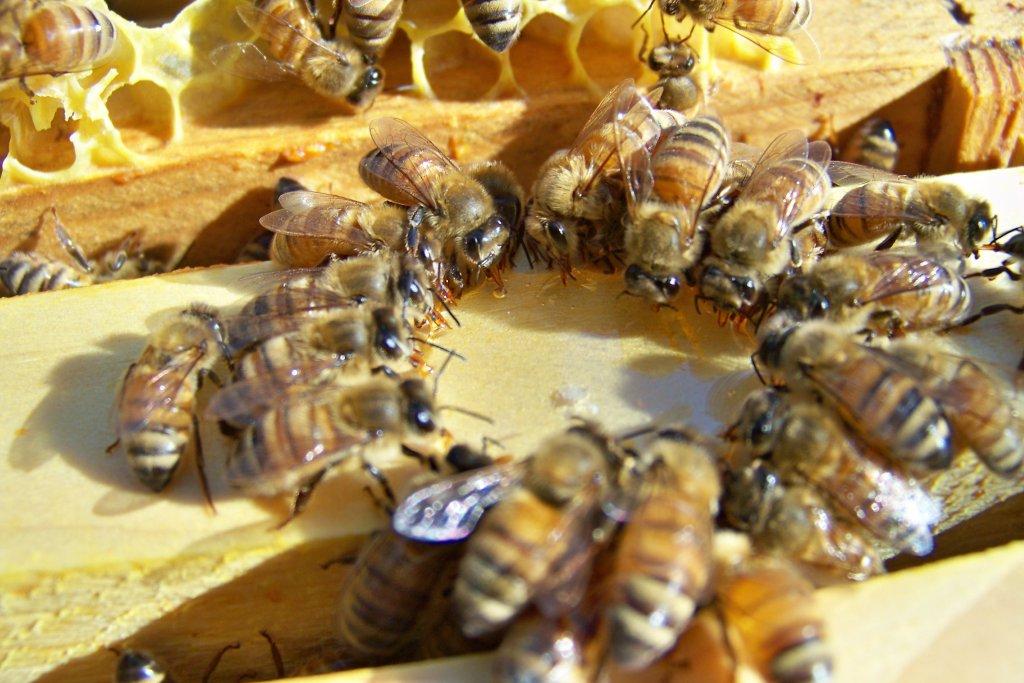
Photo by Clay "Bear" Kelley, VP GBA

"The only reason for making a buzzing-noise that I know of is because you're a bee...The only reason for being a bee that I know of is making honey....and the only reason for making honey is so I can eat it. "
~ Winnie the Pooh in A.A. Milne's 'The House at Pooh Corner'

~~~~~~~~~~~~~~~~~~~~~~~~~~~~~~
Dear Aunt Bee,
     I was inspecting my beehive and talking on the cell phone at the same time when a bee flew into my mouth.  Needless to say, I got stung.  Now my lips are so swollen, they look like I've just had cosmetic injections.  What is the best remedy for this?

Painfully yours,
Colla Jen


Dear Colla Jen:
     Pat wet tobacco on the sting area in your mouth as soon as you can.  If you get a sting anywhere else on your body, put ammonia or a new penny on the bee sting.

     And seriously, don't you know that cell phones cause CCD?

Your concerned Aunt Bee   

(contributed by Chris Pahl with Linda Tillman)


~~~~~~~~~~~~~~~~~~~~~~~~~~~~~~


"Rex non utitur aculeo!  This Latin phrase translates a “The king has no sting”.  It was used by Louis XII of France in 1506, appearing on his breastplate, which was edged with golden bees and beehives. " (Taken from THE SHAMANIC WAY OF THE OF THE BEES. )


~~~~~~~~~~~~~~~~~~~~~~~~~~~~~~


A Challenge to All Georgia Beekeepers
by Clay "Bear" Kelley, GBA Vice President

I want to pose a challenge to all Georgia Beekeepers.  And that challenge is....to start beekeeping programs in every state park in Georgia.

Not so long ago (about a century), a lot of folks kept bees in their yards, farms, ranches and wherever they could produce honey. Honey wasn't available in stores as it is today.  Then honey became available in supermarkets on a year round basis, many communities set rules barring beekeeping, family farms started to shut down and beekeeping came to a slow down.  The folks who knew the importance of honey bees dwindled to a some hobby keepers and commercial pollinators.  Now with being "green" becoming the in thing, more and more people have become interested and concerned.  You members of GBA are part of that new generation of people who care.

Our state parks are great examples of green areas with outdoor education programs that are open to the public.  What better platform to use for beekeeping education?  I have worked with Georgia Veterans State Park for two years, developing their beekeeping program and training their Rangers and management.  We have solved the legal problems and the funding problems.  We also have started a program at Chehaw Park in Albany, thanks to the members of the Southwest Georgia Bee Club.  We have just received permission to place bees at President Jimmy Carter's boyhood farm in Plains, which is now a National Park.  Special thanks go to De Wayne Pitts for his generosity and time.  We are also preparing to start a program at Reed Bingham State Park, south of Tifton.  Their management is excited and stands to get started.

There are several ways to go about starting a program.  This is a club project, so appoint a committee.  First, of course, identify your local State Park, approach the management and Friends Group President for that park.  Every state park has a separate group called "Friends."  These are a cadre of volunteers who conduct fundraisers, volunteer labor, and assist the park in any way they can.  It is a very large statewide organization.  The Friends can do things for the park that the management does not have the funds or manpower to do.

Marybeth and I are members of Friends and we just had our annual meeting at the Jekyll Island Club.  While there, I met with many of the Presidents of various Friends groups and discussed the idea of putting bee hives in state parks with them.  All with whom I spoke were in agreement that this was a great idea and were willing to support it.

Once your park management is on board, select a location and you can discuss the logistics.
We suggest these possible ways to do it:

  1. Provide at least two hives.  You manage the hives in the park and keep the honey harvested.
  2. Donate the hives, assist the Friends group with managing them and they can sell the honey as a fundraiser for the Friends Group.
  3. (we think this one is the best) Convince the Friends group to purchase at least two complete hives, bees, smoker, hive tool and suit with veil.  As you all know, that can be done at Rossman's for less than $500.  Train the park personnel on beekeeping and invite them to join your club.  Let them keep all the honey, create their own label and sell it through the Friends group as a fundraiser.  

We have allowed our park manager to join the Heart of Georgia Club at no cost to him.  We feel that one membership will not break the bank and it is sort of his duty.  He attends our meetings, is very enthusiastic, and has learned a lot.  He actually keeps three hives of his own these days.  I worked with him a lot in the beginning, but not as much now.  They have created their own label and have recouped the funds of their initial investment.  And I might add, they are very proud of every bottle of the golden stuff.

Georgia Veterans State Park has had a number of education programs since their beginning, instructing the public on the importance of honeybees.  Scouts, 4-H Clubs, school groups and the general public have benefitted from their efforts.

That's the whole idea!

I declare the program there a wonderful success.  The Parks at CheHaw have also had public programs. Ladies and Gentlemen, there's no reason why we can't make this work across the state.  We all know that Georgia has a wonderful beekeeping program.  Let's tell everyone.

If anyone needs more information, I am available to discuss this with you.  Call me, email me.  If your park manager seems skeptical, ask them to call Randell Meeks, Manager at GA Vets.  If you need the point of contact to the Friends group in your area, call me; I have that information.

Let's volunteer to share what we know.  It costs nothing but a small space in your heart and a little time!

I also want to ask Gina and Linda ("Glinda" since they are one!) our illustrious editors, to add a block in the newsletter to show the state parks that are up and buzzing and the parks that are coming soon.  So far we have Georgia Veteran's State Park and the The Parks at CheHaw who are up and buzzing, and President Carter's farm and Reed Bingham State Park coming soon.  As these parks get complete, we'll move them up to the "up and buzzing" column. Finally, if anyone knows that a state park or historic site is already keeping bees, let us know and we will add them to the list.

  
~~~~~~~~~~~~~~~~~~~~~~~~~~

As editors, we are definitely compliant with good ideas, so here goes:


State Parks with Beekeeping Programs


"Up and Buzzing"
Georgia Veterans State Park
The Parks at Chehaw

"Coming soon"
President Carter's Farm
Reed Bingham State Park

~~~~~~~~~~~~~~~~~~~~~~~~~~
April Street Cred:

If you keep bees, please participate in the survey being conducted by the Bee Informed Partnership.  The survey is being collected between March 29 and April 15.  You can participate here.

~~~~~~~~~~~~~~~~~~~~~~~~~~
GBA Club of the Month
Cartersville Beekeepers Guild

The Cartersville Beekeepers Guild is a new group in Bartow County.  We are growing at such a fast pace.  We have already had our first bee school and are looking forward to another one on May 11th at Tractor Supply in Cartersville.  Our meetings are held at Tabernacle Baptist Church, downtown Cartersville, Georgia.  We have a website with all of our meeting times.

We have a teaching hive as well as several observation hives.  We teach our members the pros and cons to all the different hives that are available in the US.  We are also planning on teaching about our native bees: how to save them and how to create bee gardens.

Since we are in the growing stafes of our guild, we don't have any guest speakers planned yet, but are looking forward to having them in the future.  We are also working out the final stages of having a location for our field day which will be for members only.

We have built the guild differently than most bee clubs.  We don't charge dues and instead of having a president and vice-president, we have directors.  I'm one of the founding directors and the other one is Tony Segura.

Stephanie Brown

                             ~~~~~~~~~~~~~~~~~~~~~~~~~~
Upcoming Bee Events
Note:  Send us your upcoming events so we can list them here!

  • SOWEGA Bee School
    • April 6, 2013, Chehaw Park
    • Details:  www.sowegabeekeepers.org
  • Young Harris Beekeeping Institute
    • May 9 - 11, 2013
    • Young Harris College, Young Harris, Georgia
    • Registration opens March 4, 2013 - this fills up quickly so register early

** Your Newsletter, Your State Association **


We are thankful for this beautiful spring day and thankful for all of your contributions to our newsletter, no matter how great or small.  This sharing is how we are together in between our meetings.  Tell a story or send us a picture - we can use it all.

Thank you also for including others in our newsletter and helping to increase the membership in GBA. For just $15 a year you get the opportunity to meet and learn from beekeepers from around the state at the two annual meetings; you can list yourself and your honey business on the GBA website; and you get to read and join us in our newsletter each month. 

As beekeepers in Georgia, we need and value your ideas and help in building our organization.

Gina and Linda
ginag@mindspring.com and linda.tillman@gmail.com

Note:  You can read this newsletter and all of our newsletters online at:
http://spillingthehoney.blogspot.com


Tuesday, February 26, 2013

March 2013 Newsletter

GBA Monthly Newsletter
Editors:  Gina Gallucci and Linda Tillman


GBA Members enjoying the reception on Friday before the conference on Saturday.


Message from our President:  Jerry Edwards

It was good to see all of you who attended the state meeting at Lake Blackshear and a hearty Thank You  to the officers who worked so hard to put it together.  The location was lovely, the resort comfy, and the program informative.  Plan now to attend the September conference which will be held in the North Georgia area.  Our goal is to meet at various locations throughout the state to optimize attendance and interest in the state organization.  Presently we are reviewing the surveys and will use them as the basis for the next meetings.  If you have any suggestions, please email ideas to any officer or board member as we welcome your input as we strive to strengthen our organization.

Jerry Edwards, President GA Beekeepers
Saving the World, One Bee at a Time

~~~~~~~~~~~~~~~~~~~~~~~~~~~~~~~~

More Photos from the "Spring" meeting of GBA
Photos all by Linda Tillman and Gina Gallucci.  Gina took the ones that are dated.  Linda took the rest of them.


~~~~~~~~~~~~~~~~~~~~~~~~~~~~~~~~~~~~~~~~~~~~~~~~~~~
A report from the front

The "Spring" meeting of the Georgia Beekeepers Association was in a lovely location at the Lake Blackshear Resort in Georgia Veterans Memorial Park near Cordele, Georgia.  About 120 people attended the conference which began with a reception and "pay as you go bar, " as Bear Kelly said,  following the board meeting on Friday night.  Chatting with other beekeepers from all over the state was lots of fun.  

Saturday was filled with talks by Georgia beekeepers and Dave Kelton (an Alabama beekeeper).  
We heard about Russian bees, nosema, raising queens, making candles, making jam.  Keith Fielder spoke philosophically about the relationship of the small beekeeper to the bigger picture and Linda Tillman spoke about the importance of working on certification at bee institutes like Young Harris.  Jerry Edwards, our president, said what we need is for all of us to educate people about honey bees.

The meals were delicious at the Lake Blackshear Resort.  Breakfast and lunch were an opportunities to share ideas with fellow beekeepers and reconnect with old friends.  The vendors had tables full of beekeeping items and seemed busy throughout the day.  Some of us had ordered ahead from vendors and were able to pick up items at the conference rather than pay for shipping.

All in all, people seemed to enjoy the conference.  There were lots of laughs and good visits with fellow beekeepers.

"The Russians are stronger than Italians bees because they have stronger mandibles because of their diet - they eat bones and Italians eat a diet of pasta!" --Sergey Volzhskiy

~~~~~~~~~~~~~~~~~~~~~~~~~~~~~~~~~~~~~~

John Wingfield (on the right in the photo below) shared this story:

At the GBA Meeting, my door prize number was called. I went to the front of the room to claim my prize, a cap. On the return to my seat the gentleman in the photo complimented me on my new cap. I  asked him if would like it. "Yes," was his immediate and very pleased answer. I handed the cap to him and took my seat. Later at the breakout session on queens I sought him out and we made this photo. I do not know his name.


You see, my wife does not like me to wear a cap. Never has, never will, at least in her presence. So I could keep my wife happy and make some stranger happy too.


Editors' note:  The "stranger" is Chris Pahl who was attending his first GBA meeting.  He is a member of Metro Atlanta Beekeepers.

~~~~~~~~~~~~~~~~~~~~~~~~~~~~~~~~~~~~~~
An ongoing message at the conference was that GBA needs to increase its members.  Many local Georgia bee club presidents are not members of GBA and each of them should be to strengthen the organization.  So instead of a beekeeping quote, we offer this:

"People who work together will win, whether it be against complex football defenses, or the problems of modern society." 
----Vince Lombardi
~~~~~~~~~~~~~~~~~~~~~~~~~~~~~~~~
A Note about GBA:

I really enjoyed attending the 2013 GBA meeting at Lake Blackshear Resort.  I drove down from Atlanta and it was really nice to get out of the city and see another part of our beautiful State.  I made some really great new friends, but also saw familiar faces from my own local bee club.  As a small beekeeper and not having a woodshop, the various vendors who attended helped me get stocked up on my seemingly endless need for various beekeeping supplies.  I think one of the benefits of attending beekeeper meetings is keeping up on the newest hive management techniques and learning the actual science behind the honey bee and beekeeping.  We had an excellent preserntation by David Kelton on nosema and a basic scientific technique for identifying the spore within the colony, and how to identify under the microscope.  I look forward to the next meeting.

by Chris Pahl, MABA member

~~~~~~~~~~~~~~~~~~~~~~~~~~~~~~~~~~~~~~~~~~~~~~~

Understanding Swarms
By Steven Page Certified Beekeeper GMBP

Colonies of bees and humans have some of the same goals.  The primary goal is to survive.  A secondary goal is to perpetuate the species, which for honey bees requires a colony to produce a reproductive swarm typically just prior to deciduous tree leaf-out.  The timing of the swarm at the beginning of the main nectar flow offers the best chance for swarm survival.

Not all colonies swam.  This can be explained by understanding the phase of maturity of the colony and the strength of the colony.  A weak colony will not produce a swarm because a swarm would threaten the colony’s survival. 

·      First year colony – getting established
·      Second year colony (one of the following)
o   Still getting established, great honey producer
o   Gets established early (mature) – produces a swarm
o   Starts the year mature – produces a swarm
·      Third and subsequent year colonies –produces a swarm

So what can a beekeeper do to reduce the chances of swarming and increase honey production? 

The beekeeper needs to understand the mature colony’s goals and functions during the late winter, in the Atlanta area this is January 20 to March 31.  It would be earlier in South Georgia and later in the mountains.

The mature colony’s goal in late winter is to swarm.  The colony spends the winter under the honey cap.  In January the queen starts laying eggs and the colony consumes honey opening up comb in the bottom of the honey cap for brood rearing and nectar storage. 

If the colony has adequate stores of honey, feeding syrup will only help the colony prepare and successfully produce a swarm. However it is very important that a colony with little stored honey be fed to prevent starvation prior to main nectar flow.  This does not require feeding continuously.  The syrup will be stored along with nectar and after an adequate number of frames are full, stop feeding.  The amount to feed will depend on; the honey remaining, weather and time remaining until late March.

The colony must shut down queen laying in preparation for swarming weeks before swarm cells are started.  This is accomplished by filling cells of emerging brood at the top of the brood nest with nectar or pollen reducing the size of the brood nest.

Opening up the honey cap can help prevent swarming.  Only supers of drawn comb will work.  Foundation will not work because the colony cannot make wax yet.  Adding empty drawn comb prevents the colony from completing all the preparations to swarm.  The large area of empty comb is used by foragers to store all the nectar they can find and the queen uses it to lay more eggs than would be possible otherwise.  If the colony is unable to fill the entire hive with nectar by early April, they with abandon the goal of swarming for the goal of winter survival.  The colony will collect nectar and store honey until the nectar flow ends in May in preparation for the coming winter. 

Two cautions when working in a colony in late winter:
1.    Keep the honey near the brood.
2.    Keep the brood frames together.

The following is a method to open up the honey cap while observing the cautions above. 

A few assumptions. 
·     
    The hive consists of a deep and a shallow super. 
·      The deep super has some combination of brood, pollen, honey and empty drawn comb frames.
·      The cluster and brood are in the deep super which is on the bottom board. 
·      The shallow super is mostly full of capped honey and is on top of the deep super.
·      It is late January and the weather is sunny and warm enough to inspect the hive. 
·      Two extra shallow supers of empty drawn comb are available.

Open up the hive and check that the cluster is in the deep super. Leave the deep super on the bottom board.  With the super of honey nearby, place a shallow super with no frames on the deep.  Add frames to the super by alternating a frame of capped honey then a frame of empty honeycomb.  Place another empty shallow super on the hive.  Add alternating frames of honey and empty comb just like the first shallow super but alternate the empty and honey frames from the bottom shallow super.  For example, if the bottom shallow has an empty frame of drawn comb on the left, the second shallow super will have a frame of honey on the left.  Add a third shallow super of empty drawn comb.

See the graphic below.

This is a front view of the hive.  You’re looking at the ends of each frame. 
Each letter represents a frame and its contents.
Brood = B, Honey = H, Empty = E, Pollen = P

Before
H
H
H
H
H
H
H
H
H
H
shallow super
E
H
P
B
B
P
H
E
E
E
deep super


After
E
E
E
E
E
E
E
E
E
E
shallow super
H
E
H
E
H
E
H
E
H
E
shallow super
E
H
E
H
E
H
E
H
E
H
shallow super
E
H
P
B
B
P
H
E
E
E
deep super

Notice how the empty and full shallow frames alternate both vertically and horizontally.

I successfully used this method last year on two hives; each produced 100 pounds of honey.  Last year’s main nectar flow was early and intense.  Many hives swarmed because of the continuous availability of nectar from early February all the way into the main nectar flow.

This method of swarm control was developed by Walt Wright.  It is named Nectar Management or Checkerboarding.

Many of Walt’s writings including Nectar Management can be found on the Bee Source website. http://www.beesource.com/point-of-view/walt-wright/  

~~~~~~~~~~~~~~~~~~~~~~~~~~~
Dear Aunt Bee,

Lucky me, I got a swarm call.  When I went to the call the bees were a little high up in the tree.  I bent the branch down and clipped it off but when I did, it split and some of the bees fell onto the ground.  I crawled around and tried to get the little buggers, but sometimes I couldn’t tell the bees from the leaves.  

I’m a big guy but I wanted to cry partly because I think I lost about ⅓ of the swarm and partly because the stings on my knees hurt like HEdouble hockey sticks.  I do think I got the queen because the bees stayed in the nuc box I brought.  

What should I have done?  I wished I had had a net like those trapeze people use in the circus.

Signed,
Scattered and Blue

Dear Scattered and Blue,

I always have a bed sheet in my swarm kit.  When I get to the site, I spread the sheet on the ground under the swarm.  That way if part of the bees don’t make it into the box I brought, then I can see them on the sheet and they are relatively easy to collect.  I also carry a plastic milk carton, with the pouring spout cut off.  I use this to scoop any bees that fall onto the sheet.

Good luck with the next time - and I hope you get a next time,

Signed,
Your Aunt Bee


(This tip was originally learned from Cindy Bee in a talk she gave to MABA on how to catch a swarm)

Aunt Bee will be a semi-regular feature of our newsletter.  Chris Pahl suggested we try this type of column.  If you have a tip for beekeeping, send it to us and we'll turn it into an Aunt Bee letter.
~~~~~~~~~~~~~~~~~~~~~~~~~~~~~~~~~~~
March Street Cred
From NPR
This is an interesting audio and article about bees and electric charges.  You can read more about it here on National Geographic as well.
 Another humorous take on bees from NPR can be found here.

~~~~~~~~~~~~~~~~~~~~~~~~~~~~~~~~~~~
GBA Club of the month
The SOWEGA Beekeepers Association

The SOWEGA Beekeepers Club is a relatively new organization which began in 2011 in Albany, Georgia.  Our mission is to provide members and the community with technical beekeeping information and an awareness of bee and beekeeping habitat, biology, and safety.  We have very diverse experience levels from Beginner to 70+ years.  Our members live throughout the southwest Georgia area.  We have several members who have completed single and multiple levels of certificatioon from the UGA Beekeeping Institute and 2 certified Welsh Honey Judges.  We also have a member beekeeper/videographer, who has made the best beekeeping DVD on the market!  "My Hive Tool" is sold at Rossman Bee Supply.

The SBC has a unique relationship with the Chehaw Wild Animal Park.  We maintain a training apiary of 4 hives, which will increase to 10, supplying Chehaw with honey for sale in their gift shop.  Our apiary provides honey bee educational opportunities for SW Georgia.  Long range plans are to build an observation hive for the part visitors.

We have members who appear on our local TV stations to promote honey bee education.  Also, we have members who speak to schools, civic clubs, and at public events.  Our annual Honey Show occurs in conjunction with the Exchange Club Fair in November each year.  Our 2nd bee school is scheduled for April 6, 2013 at Chehaw Park.  Details can be found at our website at www.sowegabeekeepers.org .  

We meet at 6:30 PM on the 2nd Thursday of every month at the Chehaw education center in Albany, Georgia.  New members and visitors are always welcomd.  Thanks, GBA, for highlighting our club.

Kent Simmons, SOWEGA President

~~~~~~~~~~~~~~~~~~~~~~~~~~~~~~~~~~~
Upcoming Bee Events

  • Queen Rearing and Breeding Workshop
    • March 1 - 2 Foley, AL
    • Roger Bemis, fee $50  Starts at 9 AM.  Bring your hat, gloves and coveralls.  You will be working in the bee yard most of the time.  No meal provided
    • For more information, call 215-213-0168 or email bemisroger@yahoo.com or write to PO Box 353, Bon Secour, AL 36511
    • Nice door prize
  • North Carolina and South Carolina State Beekeepers Associations
    • Joint spring meeting
    • March 1 - 2, 2013
    • Rock Hill, SC
  • Macon County Beekeepers Bee School
              Saturday, March 9  8:30 - 12PM
              Tuesday, March 12  6:30 - 9 PM
              Thursday, March 14  6:30 - 9 PM
              Saturday, March 16  8:30 - 12 PM
              Location:  Macon County Extension Office, Thomas Heights Rd, Franklin, NC
              To register: Contact Janet Hill 828-369-9819 or janet28734@gmail.com
  • SOWEGA Bee School
    • April 6, 2013, Chehaw Park
    • Details:  www.sowegabeekeepers.org
  • Young Harris Beekeeping Institute
    • May 9 - 11, 2013
    • Young Harris College, Young Harris, Georgia
    • Registration opens March 4, 2013 - this fills up quickly so register early
                     ~~~~~~~~~~~~~~~~~~~~~~~~~~~~~~~~~~~
Grow our Membership!
Your editors, Gina Gallucci and Linda Tillman

Gina and I had a great time at GBA.  As co-editors, we actually occupy only a single voting position on the board.  At the board meeting on Friday night, we solved that problem by voting together, raising two hands as one on each issue.  Luckily we agreed on everything on which we voted!


Gina and Linda at GBA February 2013


Most of you who are receiving this newsletter are members of GBA.  Please pass this newsletter on to a friend who is not and encourage them to join.  If the leadership of your local club is not a member, find out why and let us know.  If GBA is to serve the members, we need to know what they would like from us in order to keep people motivated to be a part of the organization.

Remember to send us your stories, beekeeping tips, and photos.  We'll turn short beekeeping tips into a letter to Aunt Bee and longer ones can be stand alone articles.  A number of you at the meeting promised us articles and stories and we plan to hold you to it!

Your editors,

Linda and Gina