Saturday, August 31, 2013

September 2013 Newsletter

September 2013 Newsletter

Editors:  Gina Gallucci and Linda Tillman
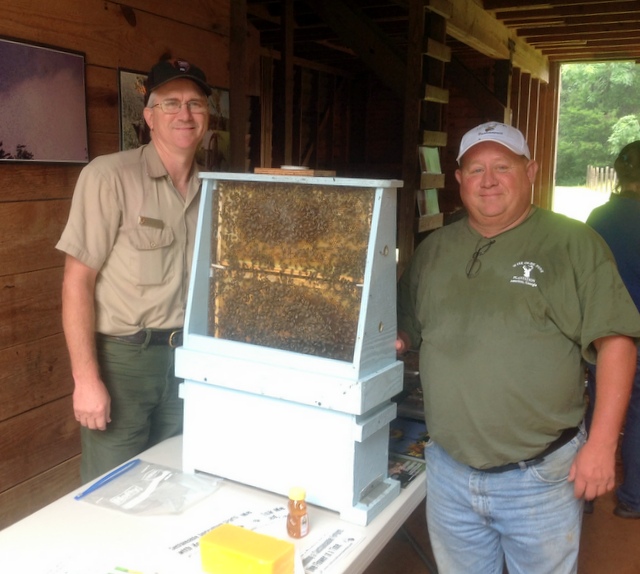

Randy Ingram, Supervisor, Jimmy Carter's Farm National Park and DeWayne Pitts, Heart of Georgia beekeeper who is providing bees for the park   Photo by Bear Kelley

Message from the President

It's National Honey Month so let's all honor our passion for bees and beekeeping by attending the state beekeeping meeting in Gwinnett County.  

Scheduled for the state meeting are the annual Honey Show, in which the winners receive monetary awards, and the election of state officers.  One of the highlights of the event is recognition of Beekeeper of the Year, an honor given to one of our deserving members.  Fourteen vendors have registered to sell beekeeping related items at the meeting. 

Later this fall in October an additional honey judging event is scheduled for the Georgia National Fair in Perry .  Please encourage your fellow bee keepers to join our organization and attend the state meeting as we continue to grow.


Jerry Edwards,  President

~~~~~~~~~~~~~~~~~~~~~~

National Honey Bee Day
by Bear Kelley, VP GBA

Saturday, August 17 was National Honey Bee Day and many places around the country celebrated the day with honey shows and bee presentations.  Not to be outdone, the management of the Jimmy Carter National Historic site put on a show as well with the Heart of Georgia Beekeeping Association at President Jimmy Carter's boyhood farm, now a national park.  Bryan Payne, President of Heart of Georgia Beekeepers Association along with several other members, set up displays, an observation hive and a Power Point presentation in the old barn.  Visitors were treated to two presentations by Bryan, Jesse McCurdy and Dewayne Pitts on the importance and benefits of beekeeping and how to  get started.

Jesse McCurdy teaching about bees at the Jimmy Carter National Historic site on August 17.

Jimmy Carter's Farm is a National Park and one of the parks in Georgia that now has a beekeeping program.  The public education available through this program is invaluable.  We should all be pushing and supporting the program to have beekeeping in your local national park.  If your club has not contacted your local park, form a committee and go to work!

~~~~~~~~~~~~~~~~~~~~~~~~~~~~~~~~~~~~~~~~~~~~~~~~

Finally, the theory and practice of beekeeping is dynamic, not static.  Our knowledge of bee biology and management grows exponentially with the passing years.  Read, attend bee meetings, share your knowledge and strive to be a good citizen in the fraternity of beekeepers. “

Dr. Keith Delaplane
First Lessons in Beekeeping

~~~~~~~~~~~~~~~~~~~~~~~~~~~~~~~~~~~~~~~~~~~~~~~~
Street Cred:  

USA- STUDY TO CHECK THE HONEY ANTIOXIDANT PROPERTIES
Sunday, 04 August 2013 08:30
Written by Analia Manriquez

In the study, 25 men took a drink of four tablespoons of honey in a 16 ounce glass of water daily for five weeks. This made the levels of antioxidants in their blood increase dramatically. Other research from this lab has shown that the darker the honey, the better it was at increasing antioxidant levels.

                       ~~~~~~~~~~~~~~~~~~~~~~~~~~~~~~~~~~~~~~~~~~~~~~~~

Ask 10 Beekeepers a Question…..

A Non-invasive Technique for Monitoring Colonies
by Tom Rearick

It would be nice to have a device that could tell you about the health of any honey bee colony in your bee yard. The perfect device has not been invented yet, but there is a non-invasive, hand-held device that you can build for less than $50 that can tell you quite a lot:
  • which colonies are thriving and which are not
  • which colonies require feeding and how much - Note: more colonies perish from starvation than CCD.
  • when major nectar flows start and stop
  • when to add supers during a nectar flow
  • how colonies & seasons compare from one year to the next
  • the population of the swarm that just flew away
By understanding the processes that account for weight gain and loss and knowing that 3500 bees weight roughly a pound, a hive scale can provide objective evidence of what is going on in your colonies.
I purchased a cast iron platform scale from Craigslist a few years ago, refinished it, and placed a hive on it. It is great for taking lots of measurements in one day but the platform scale is expensive and only practical for weighing a single hive. Over time, mud dabber wasps, rust, and critters reduce the accuracy and precision of platform scales. I like to put my hives on screened bottom boards and on stands that lift them off of the ground – but you can't do that easily with a platform scale.

Then I discovered a $16 electronic luggage scale on eBay and wondered if I could use it to weigh a hive. The result is my original pry scale design – a contraption that would make Rube Goldberg proud. It is basically a 3 prong fork that is inserted into a slot in the back of a hive. The outermost two prongs push down while the middle prong lifts and tilts the back of hive upward perhaps half an inch. That lifting force is measured by the luggage scale and is approximately one half the total weight of the hive. That enables my luggage scale with its normal maximum load of 125 lbs to weigh a 250 lb. hive.


Calibration of the pry scale shows precision to be within 1.4 lbs. of the correct weight 68% of the time. It may not be as accurate as a newly calibrated platform scale but it does not loose accuracy over time and is accurate enough that plotting the relative change in daily hive weigh provides valuable insights.

The pry scale was built for $47.22 and weighs about the same as a bathroom scale. The luggage scale came from eBay and just about everything is found in Home Depot or Lowes. The parts list and building instructions are available online at my BeeHacker blog, http://www.beehacker.com/wp/?page_id=55 or at http://www.instructables.com/id/Build-a-scale-to-weigh-bee-hives/. Beekeepers have used these plans to build pry scales from as far away as France.

To use the pry scale, I approach a hive from the rear.  I don't wear a veil because this is an entirely non-invasive, non-intrusive event.  I insert the three prongs into a slot in the back of the hive, zero out the luggage scale, then push down on the lever. A bubble level and a set screw insure that my measurements are made the same way each time – this improves precision from measurement to measurement. I then write down the gross weight which is entered into a spreadsheet later. The operation takes about 20 seconds and the bees are no wiser. I try to take measurements at the same time every day. This is because a hive in the evening can weigh several pounds more than it did in the morning.


Also on the BeeHacker blog is an interactive and annotated timeline of hive net weights throughout the year (http://www.beehacker.com/apiary). To calculate net weights, woodenware is weighed before it is stacked on the hive and then that weight is subtracted from the gross weight. A spreadsheet makes this easy.  However, what counts is change in weight so you can make really good use of the pry scale even without having the weights of the equipment before bees, wax, honey, etc. were added.

~~~~~~~~~~~~~~~~~~~~~~~~~~~~~~~~~~~~~~~~~

Dear Aunt Bee,

My bees have run away from home.  They were happy one minute with honey and brood.  Then the next time I looked at my hive, they had packed up everything and gone completely away.  I mean they didn't leave a single thing - no dead bodies on the bottom, no honey,  only three or four capped brood cells in the whole hive - gone, gone, gone.  Was I a bad bee mama?  What should I have done?

Signed,    Gone but Not Forgotten

Dear Gone but Not Forgotten,

Sometimes bees abscond.  This is different from swarming.  They completely leave the hive and take as much in their honey stomachs as they can carry.  We can't ask them but the assumptions are that they might leave for different reasons.  Sometimes if the hive is overrun with small hive beetles, the bees will leave.  Sometimes if the nectar flow has dried up and they can't find any stores anywhere, they will leave.  In most cases absconding takes place when there is no nectar flow and the bees just go somewhere and die…instead of dying at home.

Signed,  Your Sad Aunt Bee     (contributed by Linda Tillman)

~~~~~~~~~~~~~~~~~~~~~~~~~~~~~~~~~~~~~~~~~~~~~~~~~~~~~~~

Interview with Linda Tillman, Julia Mahood, and Noah Macey, all Master Beekeepers, on their Beekeeping Trip to Lithuania

Done with Gina Gallucci by email and phone

Linda, what made you say, "Yes" to this emailed travel advertisement?
Going to Lithuania on a beekeeping tour sounded like a great adventure.  And I love doing just about anything with Julia and Noah, so when they wanted to do it, I was all in.  We had no idea until we got to the country how significant bees and beekeeping are to the Lithuanian culture.  

Julia, were you interested in going right away and did you have any reservations about have your son Noah join you?
I thought it sounded a little off the beaten path, which always interests! No reservations about Noah going, quite the opposite in fact!

Noah, had you traveled internationally and if so where?  Have you been to any former Soviet block countries?
I’d traveled internationally a few times before, but never to Europe and never to any former Soviet countries.

All three, please tell us anything you were expecting from Lithuania in terms of beekeeping practices or honey production?
Linda: I assumed they kept bees pretty much like we do but we found the traditional boxes they use are not Langstroth boxes but instead are like huge trunks to hold the beehive and keep it warm during the winter.  On top of the colony inside the trunk-like hive box, they keep a stuffed pillow like you’d find on a sofa.  I asked if they picked these up on the side of the road and they said they made them just for the “family” which is what they call the bee colony.  
Julia: In addition to the old fashioned hives, they had more US like Langstroth hives, but they were built with thick walls and insulated to help with the harsh winter. They also put food grade plastic wrap over the top of the top box, before the top goes on.  In most ways, though,  it was pretty much like the US way of beekeeping. 


Linda, tell us about what kind of Lithuanian food you had and if you got any recipes?
The food in Lithuania wasn't remarkable.  They eat a lot of potatoes and fatty meat.  But I loved a "beetroot soup" that we had several times - it was like a cold cucumber soup with beets in it and was PINK!  I came home to the US, found a recipe for it online, and made it for myself within a day or two of coming back.


Noah, how were you received regarding your being a 16 year old Master Beekeeper? 
Our credentials didn’t impress anyone much--the people we spoke with assumed anyone who would embark on a beekeeping tour of a country only slightly larger than West Virginia would already have ample bee knowledge.  Also, I’m crotchety far beyond my years, so they probably thought I was older.


Linda, how many apiaries did you visit and what was your biggest surprise or impressions?
We visited three apiaries and a beekeeping museum with live hives.  The most interesting apiary was set up in an historical park to demonstrate ancient beekeeping.  The beekeeper there shinnied up trees using a hand-braided rope and a homemade wooden seat and pulley apparatus so that he could inspect beehives that were fifteen feet up.  We also visited two beekeepers - one commercial with apiaries near Vilnius, the Lithuanian capital, and the other, a sideliner with hives near the Latvian border.  Both of these different beekeepers invited us into their homes at the end of our apiary tour and fed us Lithuanian cheese, honey, mead and other treats.  The beekeepers in Lithuania face the same issues of varroa that we do, and the issue of safe nectar sources for their bees.  


Julia, what is their treatment approach?  Did you speak to anyone regarding your thoughts regarding chemical free beekeeping and if so, what was the response?
The beekeepers we visited treated for Varroa. One used oxalic acid and drone foundation to cull the mite population. The other used something in a fogger, Amitraz,  I think. Lucky Lithuanians don’t have small hive beetles!  The first beekeeper we met seemed indignant that we didn’t use chemicals in our hives.

Noah, what did you think about this exchange?
I think words like "spirited" and "lively" are the politically correct terms.  It was a conversation between a very traditional beekeeper and a very non-traditional beekeeper, and I assume that both parties must have sounded more hostile post-translation.

Noah, what can you tell us about Lithuanian beekeeping history and  culture?
           People have been beekeeping in Lithuania since prehistory. As in most areas, honey hunters slowly coaxed the bees down from the trees over thousands of years as technology improved, first in the form of carved-out logs and then in the more modern box hive. At one point, Lithuania was the biggest producer of beeswax in all of Europe.
           Lithuanians had two bee gods, Babilas and Austeja, whom they worshipped for thousands of years before the country converted to Christianity. For many years, the beekeeper served as the village mediator as he was assumed to have the most calm, patient demeanor, and during that same time period, it was customary for villagers to take off their hats as they passed an apiary.


Julia, are you able to see more similarities or differences  between U.S. and Lithuania Beekeepers?  
Beekeeping in general is more prevalent and respected in Lithuania. We traveled the country from North to South and saw beehives everywhere.

All three, could you envision hosting beekeepers from around the world for a Georgia area beekeeping tour - you know, in your spare time?
Part of the reason the tour was so interesting and so much fun was that the countryside was just gorgeous in Lithuania.  Every village had a pair of storks, for example and there were wildflowers everywhere.  We just don’t have that to show people, although I think visiting beekeepers might be interested in how we manage bees in an urban area.

All three, what is the most important or interesting thing you learned because you said yes to this opportunity? 
Linda:  I loved learning about how beekeeping affected the culture and language of Lithuania and I loved communicating with the local beekeepers.  One night in a spa town, Julia and I each had a honey massage!  With real honey!  That was a first for me.

Noah:  I found learning about the methods of early honey-hunters to be especially fascinating.

Julia:  It was interesting to visit a country that had been occupied by the Soviets, and to learn about their history.  Seeing a different way of life, living with beekeeping as an important part of the community, was really nice. 


{Note from Gina:  For those who don't know, Linda Tillman keeps Linda T’s Bees Blog and has several pages devoted to this experience.  Just search Lithuania on her blog.}

~~~~~~~~~~~~~~~~~~~~~~~~~~~~~~~~~~~~~~~~~~~~~~~~~~~~~~

“The Biology of the honeybee is constructed around using energy and material from the environment, and organizing these to ensure the propagation daughter colonies of the highest quality.  This insight is the key to understanding the amazing achievement and performance of honeybees.

Dr. Jürgen Tautz
THE BUZZ ABOUT BEES

~~~~~~~~~~~~~~~~~~~~~~~~~~~~~~~~~~~~~~~~~~

Upcoming Honey Shows
Ordered by Date

Metro Atlanta Beekeepers:  Picnic, Auction, and Honey Show on September 15.  Details here.

GBA Honey show at GBA Fall Meeting at Gwinnett Environmental and Heritage Center in Buford, GA Sept 20 - 21.  Details here.

South Carolina Foothills Heritage Fair, Oct 1 - 5 in Westminster, SC.  Honey entries due 9/28 or 9/29.  Details Contact Jeff Blackwell

WELSHfest and Honey Show, March 15, 2014.  Rockmart, GA

~~~~~~~~~~~~~~~~~~~~~~~~~~~~~~~~~~~
Bee Club of the Month

Because everyone should come to GBA's Fall Meeting in Gwinnett, we are not featuring a club of the month.  All of our Georgia clubs are the clubs of this month and should be represented in Gwinnett at the fall meeting.

                                          ~~~~~~~~~~~~~~~~~~~~~~~~~~~~~~~~~~~
Survey Results from August

We wanted to know how you learned to keep bees.  21 of you answered our survey.  Of those who answered:

63.2% of you read a lot of books and articles
47.4% of you took a short course
42.1% of you studied web sites, blogs and forum sites on the Internet
21.1% of you found a mentor
10.5% of you learned from a family member who is a beekeeper
5.3% of you took a certified beekeeping course

Create your free online surveys with SurveyMonkey , the world's leading questionnaire tool.

Please have fun and participate in this monthly one question survey by clicking on the link in blue.

                                          ~~~~~~~~~~~~~~~~~~~~~~~~~~~~~~~~~~~


Recipe of the Month

The featured recipe this month can be entered into the Honey Contest at the fall meeting of GBA.  It must be made by this recipe and submitted by noon on the first day of the meeting (Sept 20):

Plain Honey Cake

2 cups self-rising flour
8 oz honey by weight
9 ½ Tablespoons butter
2 eggs
Pinch of salt
Cream together butter and honey. Beat eggs well and add alternately with sifted flour and salt to 
the honey/butter mixture. If needed add a little milk.
Bake in a greased 8 inch round cake pan at 325 degrees for 35 to 40 minutes or until a tooth pick 
comes out clean. 


No additions to the Honey Cake Recipe Please!

                                            ~~~~~~~~~~~~~~~~~~~~~~~~~~~~~~~~~~~


Beekeeper Bytes


Georgia Beekeeper Christine Fahrnbauer was featured in Enjoy! Cherokee.  You can read the article about her here.
                                           ~~~~~~~~~~~~~~~~~~~~~~~~~~~~~~~~~~~
Steve Page sent us this very interesting link explaining the long shelf life of honey (think Egyptian tombs!).  Thanks, Steve, for your ongoing contributions to this newsletter!
                                            ~~~~~~~~~~~~~~~~~~~~~~~~~~~~~~~~~~~
The Final Buzz

This newsletter is at its best when we get lots of contributions.  Please send us your stories, your photos, your beekeeping news.  We love to share your material with beekeepers all over the state.  We also publish this newsletter online here.  People are coming from other places to read it.  Since Gina and I began editing it, there have been 3344 visits to our web publication of Spilling the Honey!  Although most people who visit our page are from Georgia, we've had visitors from Virginia, Alabama, California and even Australia in the last month.  We'd love to put your news and information in the newsletter to share with others as well.  Let us hear from you.

                                                      Linda and Gina  

Wednesday, August 7, 2013

August 2013 Newsletter

GBA Monthly Newsletter

August 2013
Editors:  Gina Gallucci and Linda Tillman


Mr. Bobby Colson of  B&G Honey in Statesboro, teaching Thomas Lariscy about beekeeping.  Photo by Denise Lariscy

Fall is approaching and bringing exciting activities for all members.   The
topics of the recent board meeting in Macon centered on the fall club
activities. The state meeting, which is scheduled for September 20th & 21st,
in Gwinnett County  and is hosted by several north GA clubs, promises to be an
informational and busy weekend for beekeepers of all levels.  

Note:  All clubs have one vote at the GBA state business meeting in Gwinnett county.  The representative, who is usually the club president or the designated voting member, MUST be a member of the state club.  If the club president is not a GBA member and thus unable to vote, the name of the designated member must be sent to Mary Cahill-Roberts ( maryc7@aol.com) two weeks prior to state meeting.  Make sure that your club president is a GBA member so that your club's voice can be heard at the state meeting.

Two separate opportunities exist this fall for placing honey in a juried
show.  The first is the state meeting with cash awards being given in
several divisions. The other contest, which will be held at the Georgia
National Fair in Perry in October, will not include cash awards but ribbons
will be earned.   Hope you are able to participate.

Jerry Edwards
President, GA Beekeepers Association

~~~~~~~~~~~~~~~~~~~~~~~~~~~~~~~~~~~~~~~~~~

Membership Report
by Roseanne Dorn

Thanks to everyone for promoting GBA!  We currently have over 200 paid memberships, of which a little over thirty percent are family memberships.  That gives us a total of 277 members!   

If everyone will encourage their local club members to join GBA, we can easily reach 300+ members by the fall meeting.  (Don’t forget to renew your own membership!)  

Memberships can be renewed online at www.gabeekeeping.com  and the printable mail-in registration for the fall meeting is also available.  Online registration is available.  
Early registration will end Sept 14th, registration at the door will be $10 per person higher so don’t wait!
                                ~~~~~~~~~~~~~~~~~~~~~~~~~~~~~~~~~~~~~~~~~~
Life is the flower for which love is the honey.  ~~ Victor Hugo
~
~~~~~~~~~~~~~~~~~~~~~~~~~~~~~~~~~~~~~~~~~

Your editors are lucky to receive a number of newsletters from Europe every month.  Here's an article from the Nottinghamshire Beekeepers Association newsletter that we thought would be of interest to all:

COULD A BEE SURVIVE A FALL FROM A SKYSCRAPER? 
by Stuart Ching (adapted from BBC Focus magazine) 

A bee (presuming it cannot fly for some reason) can survive a fall from any height because it is very light. Although Galileo demonstrated that gravity accelerates bodies at the same rate, irrespective of mass, this will only continue indefinitely in a vacuum.

When falling through air any falling object – in this case a bee – is subject to friction and this increases the faster it falls. At a certain point the deceleration from air resistance exactly balances the acceleration due to gravity and the bee stops getting faster. This is what’s called terminal velocity for that object. The terminal velocity of a skydiver is about 55m/s; a diving peregrine falcon can reach about 90m/s. 

A bee, on the other hand, will stop accelerating by the time it has reached 1-2m/s. Not only is this much slower but the bee’s slight mass also means that it’s kinetic energy at a given speed is much lower. So a bee hitting the ground at terminal velocity only has to absorb a miniscule fraction of the energy of a human falling from the same height.

In fact, anything up to the size of a mouse can survive a fall of any height without injury and cats regularly survive falls from tower block windows with only minor injuries.

However, if the bee is inside a hive then a different end result will occur. The hive having a large mass will hit the ground with considerable terminal velocity and smash to smithereens. According to Einstein, the bee, being part of this bigger system, will be crushed to a pulp!!!

                            ~~~~~~~~~~~~~~~~~~~~~~~~~~~~~~~~~~~~~~~~~~

Interview with Jennifer Berry
Research Professional III  and UGA Bee Lab Manager

Done with Gina Gallucci by telephone
Photo by Linda Tillman  April 15, 2010 at Metro Atlanta Bee meeting

How long have you been involved in beekeeping and how did you get started? 
About 17 years ago I took a class with Dr. Delaplane at UGA. By the second day I knew honey bees were going to be apart of my graduate work. Then the next week, when we opened our first hive, I knew honey bees would be apart of my life forever.

You have done a tremendous amount of teaching beekeeping. What are the hardest question new beekeepers ask? 
It's hard in the beginning for new beekeepers to even ask the right questions because they don’t have a solid base yet. This understanding comes with time and experience; trust me I know, I was a beginner once. Yet, the hardest concept to get across to beekeepers is the seriousness of Varroa mites; how to control them, how to manage them and understanding the whole mite/bee relationship. There are some people who think they can purchase a hive of bees, put them in the backyard, and leave them be. Months later, when they finally do check in on their bees, they are confused as to why they’re dead. There’s simply more to keeping bees now than before mites came ashore.

There was a time when that approach was common, how long ago do you think that was?  
I’d say anytime before the 80s. The 80s brought in Tracheal Mites and Varroa. Also since that time, bees have had a whole array of things to deal with: destruction of natural habitat which leads to lack of natural forage which leads to nutritional deficiencies, compound that with diseases, and a toxic environment inside and outside the hive.
 
What is your favorite part of teaching beekeeping?  
Overall, the whole process, especially teaching new beginners; but I focus so much on Varroa IPM. Now I am really working toward encouraging “realistic” natural beekeeping. What that is in a nutshell, is keeping your bees alive, which means one day, you may have to feed or treat for mites. But let's try as many “natural” approaches as possible first; purchase resistant Queens, use screen bottom boards, do drone brood trapping, and brood cycle disruption all to keep the Varroa mites below the threshold level. (the threshold being 40 mites in 24 hours). But if the mite levels become too high and are threatening the life of your colony, you have to do something, and treatment is usually our only option. I believe when you become a beekeeper, you must take on the responsibility for those bees: their care and welfare It’s just like taking on the responsibility of any pet you take home: dog, cat. And if need be, you would treat your dog or cat for fleas and ticks, so why not your bees?. If you don’t want to take care of the bees then you shouldn’t be a beekeeper. This may be a strong statement, but it is not fair to the bees.

How do you compare teaching at beekeeping clubs and the Young Harris Institute?  
I really enjoy Young Harris because I get a lot of down time with individuals. I get to really talk with them. At the clubs, I’m usually driving home after the meeting is over and don’t have as much time to talk with them.

Who are your beekeeping mentors? 
Bob Binnie! Let me see, did I mention Bob Binnie! I call upon him numerous times during the year to ask questions and he always makes himself available. Also, Carl Webb, Jerry Hayes, Dr. Marla Spivak, and Dr. Tom Seeley.

What is your favorite book or movie about beekeeping?
For books, I recommend several, Biology of the Honey Bee by Mark Winston. Honey Bee Biology and Beekeeping By Dewey Caron and Larry Connor, The Beekeepers Handbook by Diana Sammataro, ABC & XYZ of Bee Culture, and The Hive and the Honey Bee.
Plus All of Tom Seeley's books, (Honeybee Democracy, Honeybee Ecology, and The Wisdom of the Hive.)

No movies, well maybe Ulee’s Gold (1977).  I have seen several documentaries which I have found disturbingly incorrect and not addressing the seriousness of what honey bees are truly facing today, but instead highlighting silly beekeepers, rubbing their mustaches on bees to show how cool they are. 

Where do you see beekeeping in the next 10 years?   
We have some serious issues ahead. It’s going to be rough for our bees, yet I am optimistic. There is no single answer; there are layers upon layers of complexities that we need.

                               ~~~~~~~~~~~~~~~~~~~~~~~~~~~~~~~~~~~~~~~~~~

Recipe of the month:
Recipe for Honey Rosemary Lemonade


12 lemons, to make about 2 cups of juice
1/2 cup sage honey or a local variety
Fresh rosemary
1 cup + 8 cups water

Make a simple syrup.  Combine the honey with 1/2 cup water in a small saucepan.  Bring to a boil.  Turn off heat.  While the syrup is still hot, add whole rosemary rosemary springs and leave in the syrup.  Squeeze 12 lemons.  Combine the lemon juice with the rosemary syrup.  Add water to syrup/juice mixture.  Add more water if needed, remembering that once you add the juice to ice in a glass, the ice will melt and dilute the mixture to some degree.  Put a spray of rosemary in the glass and serve!

                            ~~~~~~~~~~~~~~~~~~~~~~~~~~~~~~~~~~~~~~~~~~

Heart of Georgia Beekeepers Speak to Master Gardeners on Beekeeping

Jesse McCurdy and Steve Prince, both GBA Members, spoke to the Master Gardeners (MGCG) on June 4th in the Old Perry Courthouse hosted by the South Chapter MGCG.  According to the July Weeders Digest this was “a very entertaining presentation on beekeeping“.  

In another article they reported it  “the meeting was a-buzz …were treated to all things bees…” by local beekeepers Jesse McCurdy who has been beekeeping for over 70 years.  He explained the importance of bees for propagation, the precarious state of the bees.  He also had an empty hive with a super and described how each part was used in the production of honey. And, the main occupants queen, drone and workers.  Plus, their function and how they interacted with each other.  

Steve Prince discussed some of his beekeeping experiences and both Jesse and Steve took many questions about bees, including “Killer Bees”, honey extractions, Chinese dumping contaminated honey on our markets.  The audience asked many questions and the meeting ran longer then usual.  Jesse also discussed why a growing number of homeowners wanted to have bee hives in their back yard.  

                            ~~~~~~~~~~~~~~~~~~~~~~~~~~~~~~~~~~~~~~~~~~   

Beekeeper Bytes

GBA member Linda Tillman was featured in a Weather Channel video shown across the country in early August.  If you'd like to see the video, click here.

P.S.  If a Georgia beekeeper you know is on TV or in the news, pass that on to us so we can share it in Beekeeper Bytes

                             ~~~~~~~~~~~~~~~~~~~~~~~~~~~~~~~~~~~~~~~~~~ 

Ask Ten Beekeepers a Question…..
When is a Swarm not a Swarm?
by John Wingfield  

Before answering, read my story!  Got a visit from a neighbor I had never met   She lives about five blocks away in our subdivision. Her first words were "do you keep bees?"  Well she told me about her friend who had a swarm of bees at her house.  Could I help?  After getting the friend’s number I called and headed to her subdivision about four miles east of Perry, Georgia.

The friend was in her yard, waiting for me.  Her home was a very nice two story brick constructed in the last ten years. The swarm was in the corner where two walls met on the west side.    It looked like the bees would fill a five gallon bucket. I told her I could remove them. So, I called Jesse McCurdy, local beekeeper guru, asking him to loan me his bee vac system. He said "yes".

Returned home and collected
a deep hive with ten frames and a matching super as it looked like a at least five gallons lot of bees to me.  Then I went by Jesse's to get his bee vac and advice. This would my second swarm this year. Last time Jesse captured the swarm for me.  This time I was alone. Rain began pouring while picking up the bee vac.  Drove to the swarm location.  

Raining again, this time with lightning!  Going to sit in my truck until this storm moves away. Kept checking cell phone weather maps to see when it would stop. Must have spent over 45 minutes waiting.  Beginning to clear.  Set up the equipment and the ladder. Ready to capture the bees.  The lady of the house and her daughter are watching from the yard at a safe distance.

Climb the ladder and start vacuuming bees into the deep hive.  Then, I see it.  Comb, big comb hanging from the metal soffit. Some comb hanging down greater then 12 to 15 inches and lots of it. I need to stop as I expected a swarm of happy bees who would not be defensive.  Did not have on veil or gloves. Better put them on as these girls are not in a swarm mood.  

From the coloration of the brood comb I estimate that at least two or maybe three generation of brood have emerged.  Maybe more. This colony has been here for at least several months. So, the colony got started late May or early June.  Borrowed a long PVC pipe and dislodged most of the comb which fell to hurriedly spread plastic bags on the ground.

So I suit up and start collecting bees again until I have most of them. Still have a couple of combs that I have not been able to dislodge. Will return tomorrow and remove the comb and pick up my ladder.

This colony was in the open under the eve. Since it was a working colony,  it is not a swarm. All though it first look like a swarm, it is really a hive without walls....a colony that had been thriving for months.  It may look like a big swarm, but it just may turn out to be something else.  It could be a colony masquerading as a swarm.


LESSON LEARNED.
 When you go to capture a swarm, take a tool for removing comb, plastic bags  or other containers for storing comb with brood and comb with honey.  You might even want to bring a smoker.

                                  ~~~~~~~~~~~~~~~~~~~~~~~~~~~~~~~~~~~~~~~~~~ 


Dear Aunt Bee,

My wife is angry and I need your help.   The first thing I did wrong was to borrow her best apron to wear while I harvested honey.  The second thing I did wrong was that I harvested my honey in her kitchen and afterwards everything was sticky, even the doorknob.  The third thing I did wrong was to tell her we were lucky to get such a large honey crop.

I think I’ll be sleeping on the couch for a while.  Can this marriage be saved?

Signed,
Sticky Footprints

Dear Sticky Footprints,

What a mess!  Next time try putting flattened cardboard boxes under your hive boxes that are in the kitchen waiting to be harvested.  Also you can put flattened cardboard on all the counter tops and over the floor surfaces.  

When you are done, take the cardboard , covered with sticky honey, out to the  yard so the bees can clean it up (they will, enthusiastically).

Good luck moving back into the bedroom,

Signed,    
Your Aunt Bee   

(contributed by Linda Tillman)

                              ~~~~~~~~~~~~~~~~~~~~~~~~~~~~~~~~~~~~~~~~~~ 

Survey Results from July

   29 people answered our survey about critters in the hive. 

          27 have found small hive beetles
          23 have found ants
          19 have found roaches
          16 have found wax moth larvae
          13 have found earwigs
            4 have found mice

  Others reported lizards, spiders, wasps, tree frogs, and a luna moth.  Oh, and varroa mite - can you believe we left it off of the list - I suppose because they are in everyone's hives.


Luna Moth hanging on a beehive (an unusual critter on rather than IN the hive)  Photo by Linda Tillman near Emory on 6/14/2013

          This month our survey is about how you learned to keep bees.  It's fun and only will take a minute.   To participate in this one question survey, just click here.   (Or answer the questions below!)


Create your free online surveys with SurveyMonkey , the world's leading questionnaire tool.

                              ~~~~~~~~~~~~~~~~~~~~~~~~~~~~~~~~~~~~~~~~~~ 
Club of the Month:  
Metro Atlanta Beekeepers Association
by Curt Barrett, Vice President

Metro Atlanta Beekeepers Association is a thriving club of over 200 members living in and around the city of Atlanta.  The club promotes public awareness of the value of honeybees and hive products, provides learning opportunities through meetings, classes and the Internet and assists its members and others with beekeeping.  MABA is the state's oldest beekeeping club and its members range from 1st year "newbees" to veteran masters with decades of experience.

MABA's monthly meetings are held the 2nd Wednesday of each month at the Atlanta Botanical Garden.  Featured speakers include top domestic and international scientists, local and regional experts and seasoned club members.  Topics run the education spectrum from beekeeping basics to hive products to the latest in scientific research news.

Each January the club offers a full, one-day "Short Course" for those contemplating beekeeping.  This popular event taps out at 110 attendees and sells out every year.  Bee biology, colony dynamics, hive components and integrated pest management are among the lecture topics.  Attendees enjoy a nice lunch, honey ice cream and adjourn with a goody bag full of helpful information and a one-year club membership.  Attendance to the Short Course is free for 5 student scholarship winners.

Club members enjoy access to free, frequent hive inspection clinics in several locations around the city while seasoned members safely remove swarms in the metro area during swarm season.  The club maintains honey extraction equipment and makes it available to members for a reasonable rental fee.  New members learn from mentors and through the club's "Bee Neighbor" program.

In the Summer the club puts on a Junior Beekeepers Program where fully suited children ages 7 to 12 participate in a live hive inspection, put together a beehive frame, view presentations about honeybees and help with honey extraction.  

Summer is also a time when the club, in conjunction with the University of Georgia Master Beekeeper Program, offers a review and testing for the program's "Certified Beekeeper" level, the first of four.  Instruction and testing for the remaining levels of certification is done at the Young Harris – UGA Beekeeping Institute.

Each September the club holds its annual Honey Contest and Auction fundraiser and hosts a Holiday Party in December.

Visit the MABA website to learn more about us.  

Curt Barrett

Vice President
Metro Atlanta Beekeepers Association

                            ~~~~~~~~~~~~~~~~~~~~~~~~~~~~~~~~~~~~~~~~~~ 

We have been informed that Freda Sikes, long time GBA member and supporter, has been diagnosed with colon cancer.  She will be having surgery in the next month.  She and her family need our thoughts and/or our prayers.

                           ~~~~~~~~~~~~~~~~~~~~~~~~~~~~~~~~~~~~~~~~~~ 


Bring your Friends and Come to the GBA Fall Meeting: 

The theme of the conference is Interconnection  

Speakers include Bob Binnie, Jennifer Berry, Patty Parsons, Jay Parsons, Bill Owens, Keith Fielder, Robert Brewer, Dave Miller, Mary Cahill-Roberts, Bear Kelly, Chris Wiley, Tom Hill and Serge Vohlzhskiy.  The meeting will be held at the Gwinnett Environmental and Heritage Center in Buford.  There's a honey show, silent auction and the award of Beekeeper of the Year.  Do come and support your state organization.  It all happens on September 20 and 21.

You can register and pay your annual dues online by clicking here.  


Lodging is available at a rate of $89 per night (including breakfast) at the Holiday Inn Express in Buford, GA 30518.  Tell them you are with the “Bee Group.”   Their phone number is 678-318-1080 

                        ~~~~~~~~~~~~~~~~~~~~~~~~~~~~~~~~~~~~~~~~~~ 

"The reality today is that we are all interdependent and have to co-exist on this small planet. Therefore, the only sensible and intelligent way of resolving differences and clashes of interests, whether between individuals or nations, is through dialogue. "

                     ~~~~~~~~~~~~~~~~~~~~~~~~~~~~~~~~~~~~~~~~~~ 

Upcoming Bee Events

August 5 - 9:
Eastern Apicultural Society,
West Chester University,               
West Chester, Pennsylvania

 September 20 - 21:
GBA Fall Meeting, 
Gwinnett Environmental and Heritage Center, Buford, GA

September 27 - 28
Alabama Beekeepers Association
Taylor Road Baptist Church
Montgomery, AL

                    ~~~~~~~~~~~~~~~~~~~~~~~~~~~~~~~~~~~~~~~~~~ 

The Final Buzz
Linda and I get really excited to share with you what you all share with us and all of GBA.  Kudoos to John Wingfield for telling us his “not swarm” story this month and his photos.  In the electronic newsletter of today, we make use of color and shape to better communicate with each other.  Please get a friend to help document your beekeeping life and share some pictures with us for the GBA newsletter.  Pass along the joys and knowledge. 

                        Gina and Linda


Tuesday, July 2, 2013

GBA Monthly Newsletter July 2013

The hive to which we all aspire!  Look at all those honey supers!

 Hive owned and managed by Jerry Wallace, member of Metro Atlanta Beekeepers  
Photo contributed by Jerry, who manages Metro Atlanta Beeks Facebook Page

Message from our President,  Jerry Edwards
          Looking forward to a fun-filled Fourth of July with family, friends, and my girls.  Another event I am anticipating is our state meeting in September in Gwinnett County.  In order to make our organization more vibrant, let's all try to bring two friends in hopes that they will join our club.  

Beekeeper of the year will be announced at the state meeting, so nominate your favorite beekeeper. Send your nomination before August 1 to Cindy Hodges (details in this newsletter). Her email is  DunwoodyHoney@Bellsouth.net  

The statewide honey show is scheduled for the Georgia National Fair in Perry in October so start cleaning those honey jars.
Jerry Edwards, President GA Beekeepers
~~~~~~~~~~~~~~~~~~~~~~~~~~
Nominate a GBA Beekeeper for 2013 Beekeeper of the Year

Every year GBA awards Beekeeper of the Year to an outstanding beekeeper in our state.  It’s now time to send in your nominations for this award.  The nomination deadline is August 1, 2013.

Do you know of someone who exhibits qualities that inspire others in beekeeping?  Have they been supportive of our Georgia Beekeepers Association as well as the beekeeping industry?  Honor them by nominating them for this award.

We are looking for a GBA member who:
  • Exemplifies good beekeeping practices
  • Demonstrates leadership
  • Promotes Georgia’s beekeeping industry
  • Creatively solves problems of industry wide concern
  • Actively participates in local, regional, or national beekeeping organizations

Beekeeper of the Year for 2013 will be awarded at our fall GBA meeting to be held on September 20, 2013, at the Gwinnett Environmental & Heritage Center in Buford, Georgia.  

Please send your nominee’s name, address, and reasons they should earn this honor to
Cindy Hodges at dunwoodyhoney@bellsouth.net.
Remember the deadline for nominations is August 1, 2013.

Thank you,
Cindy Hodges
2012 GBA Beekeeper of the Year     
~~~~~~~~~~~~~~~~~~~~~~~~~~~~~~~~~~~~~

Honey Play Clay 

from Honey: from flower to table by Stephanie Rosenbaum

   1 cup peanut butter
   1/2 cup honey
   2 cups dry powdered milk

    Mix peanut butter and honey together until  smooth.  Add the powdered milk gradually until the clay is thick and no longer sticky.

    Have fun with kids or grandkids!

~~~~~~~~~~~~~~~~~~~~~~~~~~~~~~~~~~~~~~

Interview with Curtis Gentry

by Gina Gallucci - interview done by telephone

How long have you been keeping bees?
"Since 1975.   My Grandfather had a farm in upstate North Carolina and he had bees.  He was in the process of switching over to fixed hive boxes.  He passed away before I was born but I found a few of the colonies had survived.  I was always fascinated by bees. I went off to Clemson to be an engineer but decided I didn’t want engineering after all and went into biology instead.  I took some entomology classes. Then I joined the Peace Corp and went to Liberia to teach.  There was fellow teacher and we went out on a number of honey hunts where we took cut down a bee tree, took the comb and honey and brood and brought it all back to eat. The kids loved the brood too- it was good protein.  That was a real treat. They didn’t really keep bees but they did hunt honey bees.  One time I tried to get a swarm and fell out of a mango tree.
Later, I went back to grad school at Clemson and they had a little apiary which I worked with a fellow grad student. I always loved bees." 

What's the best part of practicing beekeeping?
"It's the connecting with nature, being outside, honing your observation skills."

How many people have you mentored over the years?
"Probably about 200.  After grad school I  taught various beekeeping and agriculture programs and workshops for the Peace Corp. I was sent Nicaragua but then the war brought me out so I went to Guatemala, Costa Rica, Paraguay, Ghana, Mali and Zaire."

What's the hardest thing for a new beekeeper to understand?
"I think that it has the cycle and you have to go with the cycle of beekeeping.   You can’t take honey anytime you want.  It's seasonal and you have to go with the cycle.  Its not up to you- you are a slave to the season and their cycle."

What's the hardest thing for experienced beekeepers to understand?
"Change, it's hard in anything to change. I am thinking of industrial beekeeping -it  hit a wall with Varroa and small hive beetle around here.  There is just a lot more you have to do now to keep bees. " 

Curtis, you have a certain way with your smoker.  What do you do?
"I have lots patience.  I light a little bit (of material) at a time at the bottom and then get it going, slowly packing in more until it's really lit from the bottom up.  When I am finished I plug up the smoker and lay it on its side to let it go out."

What changes have you made in your beekeeping?
"I am kind of passing the smoker.  Due to a number of circumstances I have slowed down a bit and  work some beginner classes at the Metro Atlanta Beekeeping Short Course,  Atlanta Botanical Garden Beekeeping , and I ran the Oakhurst Community Garden bees for three
years. That is enough for me.  I am doing more mentoring than beekeeping. I really
get a kick out of other people getting a kick out of keeping bees."


***Note from Gina:  While investigating beekeeping as a hobby back in 2004,  I looked online and the first thing I found was Curtis Gentry's book:  Small Scale Beekeeping (Appropriate technologies for Development). It was published by the Peace Corps in 1982.  Little did I know then that he would become a personal beekeeping mentor!  Although now out of print, you can read the book in its entirety online
~~~~~~~~~~~~~~~~~~~~~~~~

Bees in the Parks

State Parks with Active Beehives that are Up and Buzzing:

Georgia Veterans State Park
The Parks at Chehaw
President Carter's Farm
Reed Bingham State Park
Fort Yargo State Park

~~~~~~~~~~~~~~~~~~~~~~~~
How doth the little busy bee
Improve each shining hour,
And gather honey all the day
From every opening flower. 
~ Isaac Watts, Against Idleness
~~~~~~~~~~~~~~~~~~~~~~~~

Street Cred

Free App for Mobile phones to help with Disease IdentificationThe Disease Identification section with its photographs and descriptions is already proving very useful in alerting beekeepers to potential problems – and with their smartphone they will even be able to take photographs to compare later or send to fellow beekeepers. The main sections of the app cover disease identification and treatment, where to buy treatments, plus sections on a photo gallery.  

~~~~~~~~~~~~~~~~~~~~~~~~~~~~~~~~~~~
Our Survey of the Month

This month's survey is about critters in the hive.  It's only one question - please take our one question survey!


Create your free online surveys with SurveyMonkey , the world's leading questionnaire tool.
~~~~~~~~~~~~~~~~~~~~~~~~~~~~~~~
Dear Aunt Bee,

A while back I was consolidating my bee equipment and left some frames with plastic foundation sitting in an open environment in my bee yard for several months.  A lot of the wax was scraped off, but they looked pretty cruddy.  

I wanted to clean the frames so I removed the plastic foundation and threw it away.  Then I put the frames in a heated oven at about 300 degrees for 45 minutes over a cooking pan that would collect any drippings.

When I removed the frames, I was able to wipe off the wax and crud that remained.  Is this methos of cooking the frames an acceptable method to clean the frames for re-use?

Signed,
Pot Luck

Dear Pot Luck,

Sounds like a great plan.  I've tried that myself and found the disadvantage to be the time it takes and that you can only do a few frames at a time.

I have also cleaned frames by filling a stewpot with water and bringing it to a boil.  Then I hold one end of the frame in the water for about 12 seconds and then the other end of the frame for another 12 seconds.  

Wax and other crud can easily be wiped off while the next frame is dropped into the water.  Since it takes less than 1/2 minute per frame, then many more can be done in 45 minutes than half a dozen in the oven.

This method does not warp the frames because they are in the water for such a short time.

Either way will work to clean your frames for reuse.

Aunt Bee

Contributed by Chris Pahl and Linda Tillman
~~~~~~~~~~~~~~~~~~~~~~~~~~~~~~~~~~
“I shouldn't think even millionaires could eat anything nicer than new bread and real butter and honey for tea.” 
~~Dodie Smith, I Capture the Castle
~~~~~~~~~~~~~~~~~~~~~~~~~~~~~~~~~~~~

Upcoming Bee Events

July 11 - 13 NC State Beekeepers Summer Meeting, Sandhills Community College, Southern Pines, NC

July 11 - 13  Heartland Apicultural Society HAS 2013, Tennessee Tech University, Cookeville, TN

July 20 Queen Workshop, Foley, AL library, bemisroger@hotmail.com  $75, includes lunch

August 5 - 9  Eastern Apicultural Society, West Chester University, West Chester, Pennsylvania

September 20 - 21 GBA Fall Meeting, Gwinnett Environmental and Heritage Center, Buford, GA 
~~~~~~~~~~~~~~~~~~~~~~~~~~~~~~~~~~~~~~~
Ask Ten Beekeepers a Question…..

Creamed Honey


by Noah Macey


First of all, if you've never had creamed honey before, go buy some and taste it; the newsletter will still be here when you get back.

Now that that's been taken care of, we can get down to the nitty-but-hopefully-not-gritty  (you'll understand that joke in a minute) business of making creamed honey. 

Wait, what is creamed honey?
Creamed honey is simply honey that has crystallized so finely that the granules are imperceptible and the final product is smooth, without a gritty feeling. This creates a honey that spreads like butter and doesn’t run. As anyone who's tasted an jar of old honey that has crystallized on its own will attest, such a thing doesn’t happen without a little help.

How on earth do I make such a thing?
Harnessing the forces behind honey crystallization isn't difficult. The two main sugars in honey are glucose and fructose, and the ratio of the two sugars determines how eager the honey is to crystallize. The dusty jar of sourwood honey that the house came with is still liquid because sourwood honey has a very low ratio of glucose to fructose, whereas the cotton honey that crystallized in the extractor has a very high ratio of glucose to fructose. Creamed honey turns out better when you use a honey with a high glucose to fructose ratio, so it’s wise to use honey that has already crystallized in its jar.

We can control the size of the crystals as well. When sugars form crystals, they like to follow an example by replicating already-existent crystals. So, by introducing very smooth creamed honey (called “seed honey,” often bought from the grocery store) to your future creamed honey, you can control the size of the crystals. Of course, this means heating the honey to melt any naturally-occurring crystals that could conflict with the seed honey.

Give me step-by-step instructions.
Fine, pushy...
  1. Heat your soon-to-be creamed honey to 120 degrees, stirring gently while avoiding introducing air bubbles. Strain the honey through a fine strainer to remove possible contaminants (the final product will be very light, so any debris will be painfully visible. Not to mention crystals could form matching the size of the debris, which would make the crystals gritty).
  2. Heat the now-strained honey to 150 degrees, still stirring gently. Hold it at that temperature for 15 minutes.
  3. Rapidly cool (think: ice bath) the 150 degree honey to between 60 and 75 degrees (between these temperatures, your seed honey won’t melt, but it’s still easy to stir).
  4. Once the honey has reached the correct temperature range, add your seed honey at roughly 10% of the total weight of the soon-to-be-creamed honey (I suggest your first batch be 10 lbs of honey, which entails 1 lb of seed honey). Stir the seed honey in gently, careful not to add extra air.
  5. The honey is now ready to be placed into its final container. Said container should be wide-mouthed as creamed honey is spread, not poured. Overfill slightly because as it sets, the creamed honey will contract. 
  6. The best temperature for crystallizing honey is 55 degrees, so use your fridge. Leave it alone for one week. 
  7. Clean-up

Where does the 'creamed' come in?
I'm not sure why it's called creamed honey—there's no actual cream in it. Other names include whipped honey, spun honey, churned honey, and honey fondant.

I don’t like to heat my honey. Is there a way to keep it raw?
Nope, sorry. Even if you could keep it raw, as honey crystallizes the liquid component (which, while hard to detect in creamed honey, is still there), becomes more watery, leading to fermentation. Such fermentation happens in honey that crystallizes normally as well.
***************
Our author, Noah Macey, won Best In Show for his creamed honey at the Metro Atlanta Beekeepers' honey show in 2010.  At 16, he is also the youngest Master Beekeeper in the state of Georgia.

******************

Meeting tomorrow’s beekeepers

By Holly Bayendor, 
Metro Atlanta Beekeepers Association Junior Beekeepers Program Chair


Despite the threatening weather on April 28, twelve participants showed up for the first daylong beekeeping course offered by MABA for children ages 7 – 12.  Everyone gathered for the class at Melissa Bondurant’s veterinary office in Alpharetta.  Melissa has beehives there as well as a good facility for the educational slide show, games and activities that were all part of teaching these kids about the importance of bees and how to keep them.

Twelve children arrived with their parents and first saw a presentation by Cindy Hodges and Melissa Bondurant.  The children learned about ancient beekeeping and honey bee communication dances.  They were able to look at specimens of dried bees, honeycomb, and other pollinator samples.  They also learned about the roles each bee plays in the hive and had a fun dress-up segment. 

During lunch the children got to see a fully assembled bee hive.  All the components were labeled and they could touch all the parts. Then they looked at an observation hive where they saw the bees working, spotted the queen bee, found honey and brood. Keeping dry on the porch, the children enjoyed using hammers, nails and glue to make their own hive frame. Some of the children chose to keep their frames, while others offered theirs back to MABA for use in a real beehive.  

Thanks to a grant from the Georgia Beekeepers Association, we had purchased child sized bee suits to use in this course.  Each child found a suit to put on and we headed for the beehives.  Melissa demonstrated lighting the smoker and we opened the hives.  The children held frames of live bees and each child got to hold a drone in his/her hand.

Honey was the final feature of the course.  The children got to taste different honeys and Melissa showed them how to extract honey.   The children got to use the capping scratcher and also got to spin the extractor.

Each child took home a packet of material including a small jar of honey, a bee-bookmark, a bee cookie, a packet of wildflower seeds, an informative honey bee coloring book, honey recipes, and a certificate of participation.

In addition to the funds from Georgia Beekeeping Association which made possible the purchase of bee suits to use for years to come, we owe thanks to Cindy Hodges, Melissa Bondurant, Lula Banks-Moore, Jeff McConnell, and Realm Advertising for their help in making the course happen.

~~~~~~~~~~~~~~~~~~~~~~~~~~~~~~~~~~~~~~~~~~~~~
Club of the Month:  
The Beekeepers Club of Gwinnett
by Diane May, co-secretary

The Beekeepers Club of Gwinnett is a young and growing club.  The club was started by Tommy Bailey, current president of the club, by hosting an exhibit at the Gwinnett County Fair in September of 2010 to educate the public on honey bees and to encourage new hobbyist, backyard beekeepers. Thirty interested beekeepers attended the first ever meeting of the club at Hebron Baptist Church in Dacula, GA in October. Today the club has approximately 225 active members and regular visitors with an average of 80 attending each month.   

Our first purpose is to educate the public on the benefits of the honeybee and to help them realize it is not a dangerous, but a beneficial insect. We attend the Gwinnett County Fair yearly with an observation hive, educational materials, and eager members ready to answer questions.  Club members also volunteer in the communities by presenting demonstrations for school, community or scout groups.  We worked with Whole Foods in John's Creek as part of a Share the Buzz Honeybee Awareness event including foods and drinks made with honey as well as roasted vegetables pollinated by honeybees.

Gwinnett's second purpose is to encourage and educate beekeepers. Members share their triumphs and challenges in their hives. Speakers and hands-on opportunities each month also further this important purpose.  We maintain an extensive library of educational material and equipment that paid members are free to check out month to month.  Members are encouraged to attend educational events like the Young Harris Beekeeping Institute .  Through this continued education, the club can boast of several members that are Certified or Journeyman level beekeepers.

Beekeepers Club of Gwinnett hopes to further the cause of the honeybee and to see more hives in and around the county.  We welcome visitors each month and enjoy having seekers and beginners visit to learn and have their questions answered and to glean new information from the experienced keeper.  Please feel free to stop by on the second Tuesday of each month at 7:00 at Hebron Baptist Church, Building A, third floor and join the discussion.
~~~~~~~~~~~~~~~~~~~~~~~~~~~~~~~~~
The Final Buzz
We appreciate all the contributions to our newsletter - 
Please have fun with our surveys and keep letting us know if there there's something you'd like to see here!  Keep your articles
and photos coming - we love them.

Gina and Linda